
- Knowledge
- How it works
What happens in the water
How an alkaline bath works. Three values, nothing else.
Carbonates in the water, slightly below body temperature, for hours. That’s all you set. This page explains why these three levers are enough — and draws a clear line between what is measured, what is a model and what we don’t know.
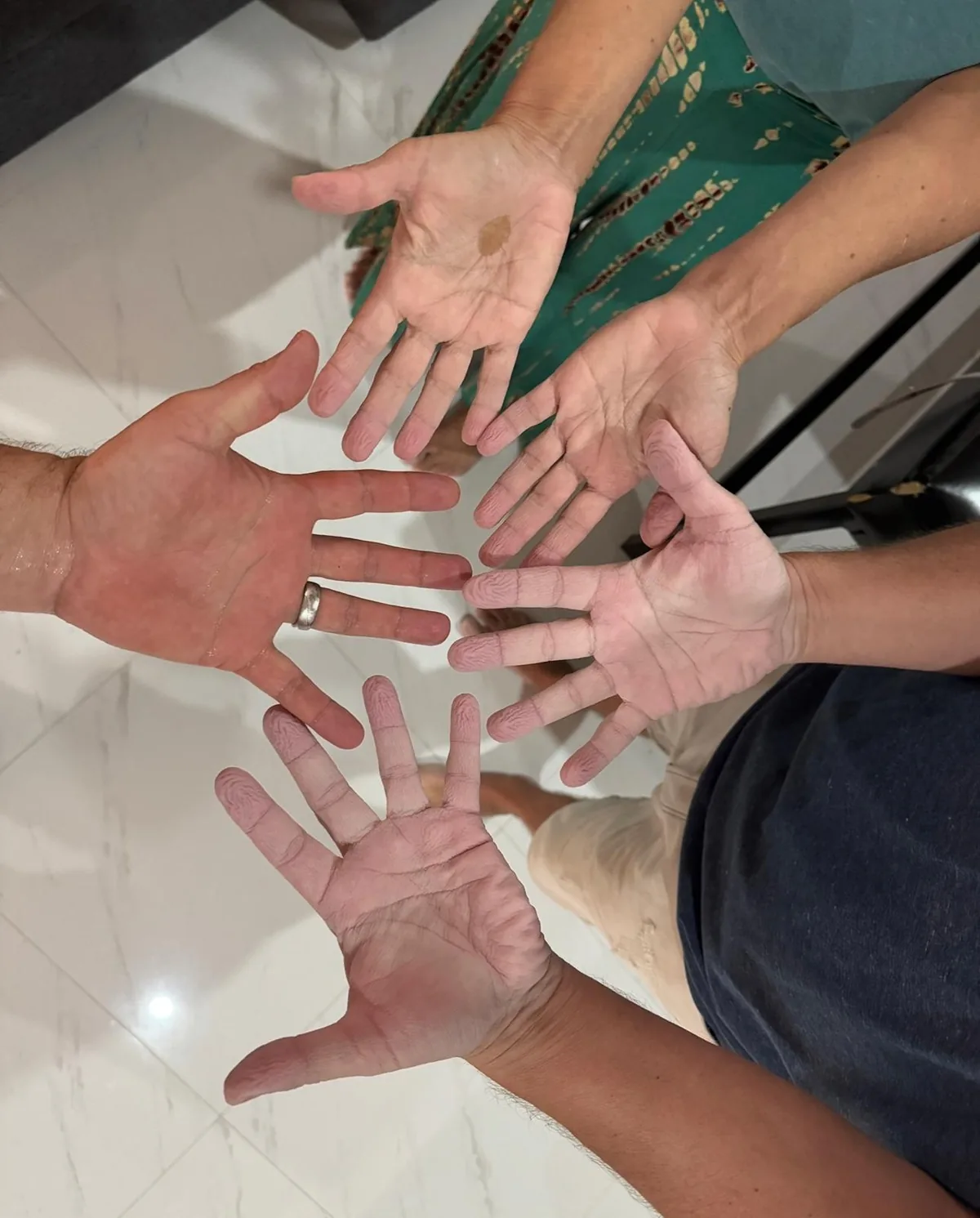
Hands after the bath — photographed at the Bathtime bathhouse, Koh Phangan.
Where the acid comes from
Over-acidification isn’t a buzzword. But our model is just that: a model.
The body works non-stop to neutralise acids and flush them out. When the load becomes greater than what it can eliminate, it stores them away. We describe where the load comes from with a model we Bathmasters work with — not a study, but the sum of more than 1,000 guided baths.
Experience-based model
Head
Mental origin
Thoughts, worries, constant stress, emotional overload — in our model, the biggest source of acid.
Plate
Nutrition
Acid-forming foods, sugar, coffee, alcohol — the familiar part, but only a small one.
Body
Exertion
Sport and physical strain when there’s no recovery afterwards.
Above all, the 70/15/15 model says one thing: your plate is not the main lever. If you only change your diet, you’re working on 15 per cent. The biggest source is in your head — and that’s exactly why a long bath isn’t a wellness appointment but hours in which nothing is asked of you.
The figures aren’t measurements. They’re our working hypothesis, and we write them down as such so you know what you’re dealing with. Experience-based model
Where the acid can get out
Your skin is your third kidney. That’s an image, not physiology.
The body has several routes of elimination — kidneys, bowel, lungs, skin. The skin is the only one you can reach from the outside. That’s exactly what the bath makes use of: for hours, it offers the skin an environment it can release into.
We say “third kidney” because the image makes it instantly clear what this is about: elimination, not skincare. Physiologically, the skin is not a kidney — it doesn’t filter blood. The image describes a role, not an organ. Image · not physiology
What you can see for yourself: after longer baths, a fine, soapy film often forms on the skin, which you wipe off into the water. What exactly it is, we don’t measure. That it’s there, you can see.
What happens to the skin in the waterDoes the skin need oils and creams?
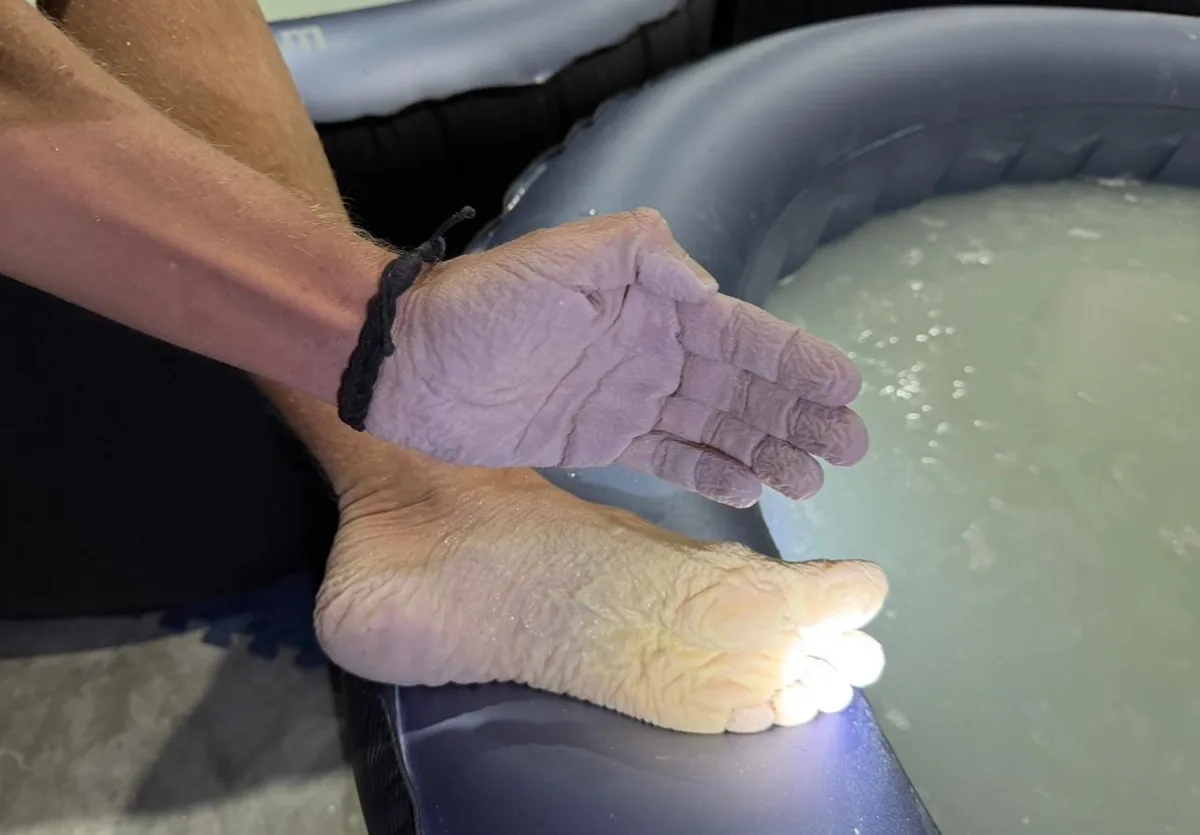
Hand and foot after hours in the water — photographed at the Bathtime bathhouse.
Why the water has to be alkaline
Bath osmosis. This is how we explain what we observe.
Two environments, one membrane, one gradient: more acidic inside, alkaline outside — the skin in between. In this picture, whatever is stored as acid in the tissue moves towards the alkaline water. The steeper the gradient, the stronger the pull.
Plausibility model
Inside
Tissue, with stored acid
What the body couldn’t eliminate, it has neutralised and put into temporary storage — according to our model, mostly in the connective tissue, and deeper over the years.
In between
The skin as a membrane
It separates the two environments and lets things through in both directions. That’s why you bathe naked, why you use no oil, why you stay in for hours.
Outside
Water, alkaline
The alkaline water is the other side of the gradient. A neutral bath offers no gradient — it’s just warm. That’s the whole difference between bathing and alkaline bathing.
Whether it really is osmosis in the physical sense, we don’t know — we haven’t measured it. We know what we see: milky water that smells different after twelve hours than it did in the morning, and people who climb out of the pool different from how they climbed in. The model gives us a plausible explanation. We claim nothing more. Experience-based model
On the pH scale, between neutral and the bath, lies amniotic fluid at 8.5 — the place where every one of us once bathed. That’s our hypothesis for why alkaline water feels familiar to the body: a lovely hypothesis that we can’t prove. Hypothesis
What you set
Three levers. Nothing else.
pH, temperature, time. You can measure all three: test strip, thermometer, clock. Everything else — dissolving carbonates, running the bath, staying in — is craft, not science.
If you have a test strip, a thermometer and a clock, you have everything you need for checking. Your body explains the rest.
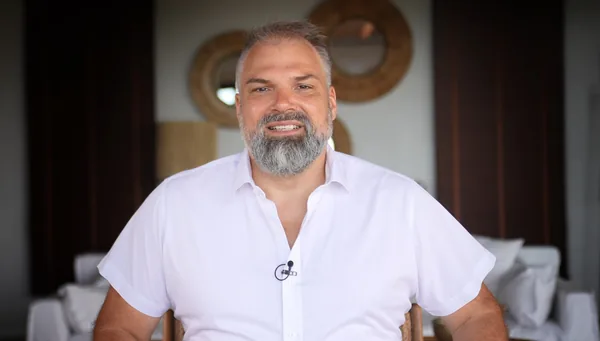 Gunther
Alkaline bathing explained — the introductory articleCarbonates and dosage
Why it takes hours
Three phases in the water. The last four hours count most.
In our experience, a long bath works in layers: first the skin, then the tissue beneath it, then the depths. The boundaries aren’t measurements but what we’ve observed in guests over the years — which is why they’re shown here as an experience-based model.
Experience-based model
For you, this means: one hour is a beginning, not a mistake. Six hours reach further than the first four. And the twelve hours at the bathhouse aren’t an endurance test but the way into the third phase. Experience-based model
The three phases — the articleHour by hour through the 12-hour bath
- 0–4 h
- Cleansing of the skin layers.
- 4–8 h
- Release of acid from organs and tissue.
- 8–12 h
- Bones and the deepest connective tissue.
Experience-based model The 0–4–8–12 h boundaries come from guiding baths, not from measurement.
Why not hot
The temperature pull. Acid moves to where it’s coldest.
Our observation: the body releases towards whatever is cooler than itself. A hot bath reverses the gradient — it relaxes you, but it doesn’t draw anything out. That’s why you get in slightly below body temperature and let the water slowly cool down.
Experience-based model

Gunther Stange — Bathmaster, not a doctor.
Where this comes from
None of this is new. We’ve just written it down again.
Gunther’s path to the water led through juice fasting and naturopathy to the discovery of a European religious order that bathed in carbonates. Guidance came from Dr Peter Jentschura, Kurt Tepperwein, Bioleo and the Polish bath practitioner Robert with his age-old Catholic knowledge. In the end there was a bathhouse on Koh Phangan — and Gunther’s mission to carry this knowledge around the world again and explain it simply.
What we do at the bathhouse isn’t a break with bathing culture but its continuation, with a test strip in hand. The long history — from the alkaline waters of antiquity to Kneipp — is told in a blog article that we prepared but didn’t write ourselves.
Where to go from here
Got it. What now?
The basics are enough to take your first foot bath. For the whole protocol, there are two ways — a free one, and one with guidance all the way to the twelfth hour.
Free video
About 28 minutes with Gunther, in English: the three levers, over-acidification as a model and why the long bath matters. No sign-up.
Free, in English, no sign-up.
Homebathing course
The complete protocol for your tub: 8 modules, 38 videos, dosage, measuring, troubleshooting, a gradual start 1 h → 6 h → 12 h. Currently only available in German.