
I recently spent three days experiencing the alkaline baths, and I cannot recommend them highly enough. I noticed a truly remarkable improvement in both my physical and mental well-being. I felt deeply rested and completely renewed. My muscles …
- Home
- Knowledge
Where to read up
Experiential knowledge. Labelled and written down.
Here you’ll find what we know about long alkaline bathing — and how we know it. Anything measured is shown as a number. Anything that’s a model carries a stamp. Whatever people have experienced remains an individual case. Four doors: the basics, the blog, the voices, the recommendations.
Water, carbonates, time — that’s all there is to it. The knowledge behind it is on these pages.
Where to start
Three levers, one mechanism. Explained on one page.
The basics page is the short version of everything we go into in depth in the video and the courses: where acid comes from, what the skin has to do with it, why the water needs hours and where our claims end.
How it works
From acid to history — seven sections
- over-acidification as a model: 70/15/15
- the skin as the third kidney — an image
- bath osmosis: how we explain what we see
- the three levers: pH, temperature, time
- the phases 0–4–8–12 h
- the temperature pull: acid moves to where it’s coldest
- history: where the protocol comes from
pHwith carbonates, measured with test strips
Temperatureslightly below body temperature, slowly falling
Timea bath works over hoursExperience-based model
You can measure all three values yourself: test strips, thermometer, clock. Everything else on this website is experience or a model — and labelled as such.
Where to read on
Alkaline topics. Four directions.
On the blog we regularly post about new topics — sorted by where you are as a reader, not by date: getting started, understanding the practice, planning Thailand or going deeper. Each topic ends with the path that suits it.
Topic 1 of 4
Getting started
Where to start if you’ve never taken an alkaline bath.
- Alkaline bathing explained
- What is over-acidification — and why does it affect us all?
Explore the topic
Topic 2 of 4
Understanding the practice
What happens in the water and how to do it right at home.
- What happens in a 12-hour alkaline bath
- The three phases of alkaline detox: deep regeneration in your bath
Explore the topic
Topic 3 of 4
Planning Thailand
The place, the island, the bathing day at the bathhouse.
- Why Koh Phangan is the ideal place for self-healing and deep reflection
Explore the topic
Topic 4 of 4
Going deeper
Background, history, models and limits.
- The Penguin Principle: why your environment affects your pH level
- Does our skin really need oils and creams — or can it take care of itself?
Explore the topic
What people have experienced
Voices from the water. Individual cases, not proof.
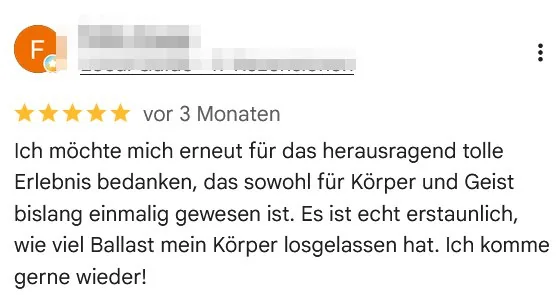
Guests and course participants write about what they experienced — calm, clarity, sleep, skin. The rule: no incentives, no selection by results. What we don’t conclude from them is noted alongside on the Experiences page.
Read the text
I’d like to thank you once again for this truly outstanding experience, which has been one of a kind so far, for body and mind alike. It’s really amazing how much baggage my body let go of. I’ll gladly come back!
All testimonials, videos and Google reviews
How these testimonials come about and why they remain individual cases — with videos and Google reviews.
What you need
Carbonates, test strips, thermometer. All on one page.
The carbonates page explains choice and dosage — and what to look for when you buy.
Carbonates
1–2g/LDosage for the bath — target pH 9.5
Four carbonates. No salt.
Food-grade sodium, potassium, magnesium and calcium carbonate. What to look for when buying, how much you need for a foot bath, tub or pool, and how to get it into the water — with a dosage calculator.
What you eat
Forty alkaline recipes. From juice to roasted vegetables.
Breakfasts, main dishes, juices and salads — mainly alkaline, without meat, milk, sugar or white flour. Plus the equipment and books Gunther uses himself.
Breakfast
10Recipes
Warm or raw, without sugar.
Millet porridge, sweet potato toast, papaya bowl, chia pudding.
See the breakfasts
Main dishes
10Recipes
Filling without meat or milk.
Pumpkin curry, roasted vegetables, cauliflower steaks, vegetable soup.
See the main dishes
Juices
10Recipes
Freshly pressed in a slow juicer.
Green alkaline juice, beetroot, pure celery, warm broth.
See the juices
Salads
10Recipes
Raw food that fills you up.
Beetroot carpaccio, potato salad without mayo, wild herbs.
See the salads
In short
Five questions that almost everyone asks first.
Is alkaline bathing the same as a salt bath?
No. Salt — sea salt, Dead Sea salt, bath salts — is pH-neutral in water. Carbonates are what make the water alkaline: food-grade sodium, potassium, magnesium and calcium carbonate. Only that can be checked with a test strip. More on carbonates.
Why pH 9.5 — and not higher?
9.5 is the starting value we recommend, provided you’re not heavily over-acidified. If you’ve had a lot of medication, intensive medical treatment or substances over the years, you’re usually heavily over-acidified and start more carefully. The pH scale is logarithmic: each step is ten times the previous one. The course teaches you how to de-acidify faster with a higher pH and where to start in your case.
Do I really have to bathe for twelve hours?
No. Twelve hours is the long format at the bathhouse. At home, you build up in stages: 1 h, then 6 h, then 12 h — and if you don’t have a tub, you begin with a foot bath.
Is this medically proven?
We share experiential knowledge from more than 1,000 guided baths, not studies. Wherever we work with models — 70/15/15, osmosis, the phases — there’s a stamp next to it. An alkaline bath does not replace a medical diagnosis or treatment. What we can’t measure, we don’t claim.
I don’t have a bathtub. Where do I start?
With your feet. An alkaline foot bath needs a bowl, carbonates and 30–60 minutes. Read the article on foot baths.
Is your question missing? Write to info@alkaline-bathing.com — we reply personally.
Rather listen than read?
In a free English video, Gunther explains the three levers — about 28 minutes, no sign-up. No supplements, no promise of healing.
Free, in English, no sign-up.