
- Home
- Carbonates
What goes into the water
Four carbonates. No salt.
Food-grade sodium, potassium, magnesium and calcium carbonate raise the pH of your bath water. Here you’ll find what to look for when buying, how much you need and how to get it into the water.
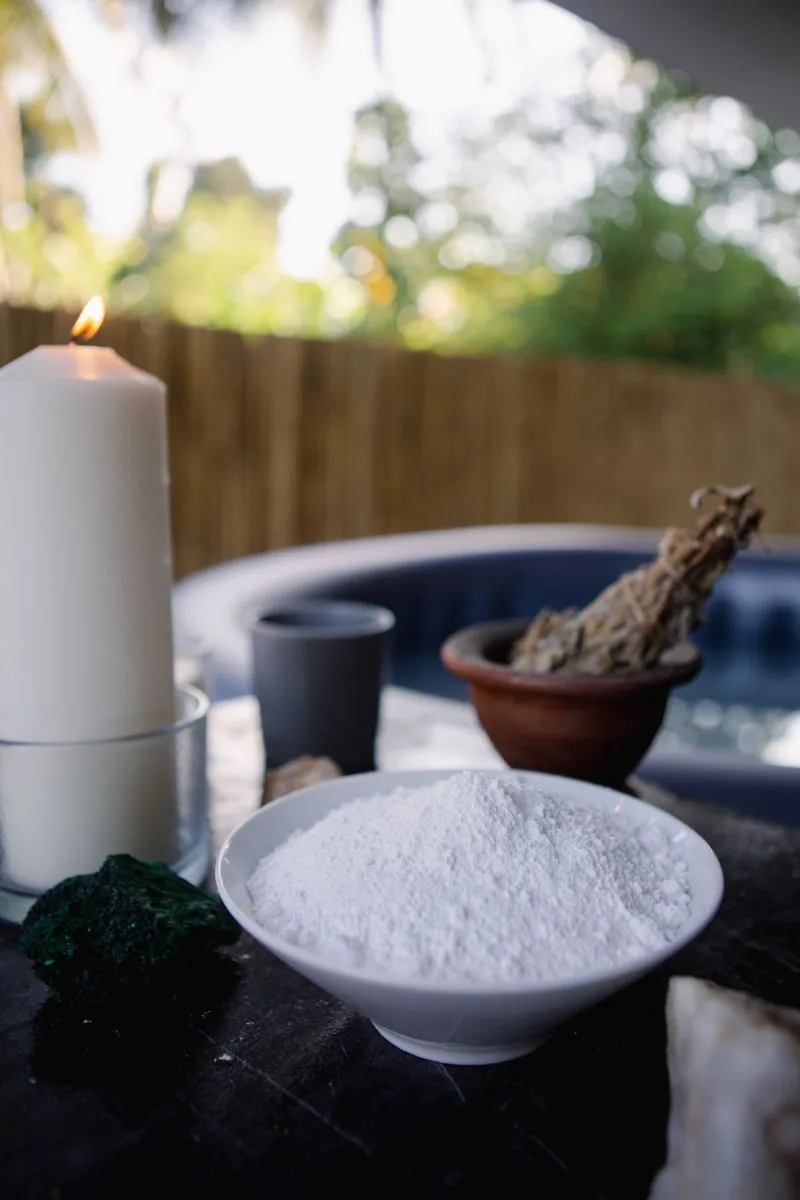
What you buy
Four substances, four E numbers. The label decides.
Carbonates are salts of carbonic acid and are approved as food additives — and that is exactly your selection criterion. Look for food grade, recognisable by the E numbers E 500, E 501, E 504 and E 170. Technical-grade goods can contain residues you don’t want in your bath water.
Sodium carbonate
Also known as washing soda. Readily soluble in water, raises the pH markedly — the main reason the water becomes alkaline at all.
Potassium carbonate
Formerly called potash. Also readily soluble and strongly alkaline; it brings potassium into the water instead of sodium.
Magnesium carbonate
Only a small part dissolves. It stays in the water as a fine haze — one reason the bath is milky.
Calcium carbonate
Chalk, basically. Barely soluble, gentle on pH — the second source of the milky colour you bathe in.
What to look for
- pure food-grade carbonates — E 500, E 501, E 504 or E 170 on the label
- without fragrance, without colouring, without oils, without an “active ingredient complex”
- as a powder you weigh out yourself — with a kitchen scale and test strips
- in a quantity that suits your volume: foot bath, tub or pool
What to avoid
- no bath salts, sea salt or Dead Sea salt — salt is pH-neutral and raises nothing
- no baking soda on its own — as a bicarbonate it stays well below 9.5
- no technical-grade goods with no quality stated
- no blend whose label doesn’t say what’s in it
An alkaline bath is not a salt bath. Salt makes the water salty — carbonates make it alkaline. And only that can be checked with a test strip.
Where you bathe
Foot bath, tub or pool. The volume sets the amount.
Three places, three orders of magnitude. The litre figures are guide values — every tub and every pool is different. If you want to know exactly, fill it once with a bucket and count. The grams below apply to 1.5 g/L, the middle of the window.
Foot bath
A bucket or foot tub, with your feet covered past the ankles. The small way in — for getting started, for in between, for when you’re travelling.
Tub
An ordinary bathtub, full enough to lie in. A little less or more depending on the model — the standard for Homebathing.
Pool
A spa pool like the ones we use at the bathhouse. For long baths and for your own bathing spot.
Your reading
Litres times grams per litre. That’s all the maths there is.
Enter your volume and the dosage you want to start with. The result is the amount of carbonates for this one bath — weighed, not guessed. The test strip then shows you the pH.
Then measure: test strip into the water, target 9.5. Too low? Dissolve more in small steps.
Safety: do not inhale the powder, avoid contact with the eyes, keep out of the reach of children, do not ingest.
Where to get them
Currently only in Germany.
Our carbonates are currently only available in Germany. Interested? Put your name on the list and we will let you know as soon as they are available outside Germany.
What we don’t compromise on
Carbonates are chemicals. Treat them that way.
Handled correctly, carbonates are unproblematic — but sodium and potassium carbonate irritate the eyes and airways. An alkaline bath is not a wellness add-on but an intervention in the pH of your water — and chemicals demand care.
- Start slowly: a foot bath or the lower end of the window, then build up. The pH is measured, not felt.
- If you experience itching, burning or discomfort, end the bath and rinse off with clean water — and next time use a lower dose or bathe for a shorter time.
- If you are pregnant, have an existing medical condition or take medication, talk to your doctor first. An alkaline bath does not replace treatment.
- Rinse the tub or pool with clean water after the bath — carbonates leave a white film that can be wiped off.
Bathmaster, not a doctor Everything on this page is experiential knowledge from more than 1,000 guided baths — not medical advice. You decide, you measure, you take responsibility.
What people often ask
Seven questions about carbonates. One about the search term.
Why we don’t say “alkaline bath salts”
Because there’s no such thing. Salt — sodium chloride, sea salt, Dead Sea salt — is pH-neutral in water. It makes a bath salty, but not alkaline. It’s carbonates that raise the pH. Products sold under this name usually contain carbonates — often together with bicarbonate, salt, fragrance or colouring. The label tells you what’s inside.
We call things by their proper names so that you can tell from the label what you’re buying: food-grade carbonates. Nothing else. If you searched for “alkaline bath salts”, you’re still in the right place — now you just know what to look out for.
Is baking soda from the kitchen enough?
Baking soda is sodium bicarbonate (E 500ii). It’s a good buffer, but a weak one: a baking soda solution stays well below pH 9.5, no matter how much you add. For a foot bath to try things out, it’s fine — for a bath at 9.5 you need sodium carbonate (E 500i), the real carbonate.
How do I know the pH is right?
You measure it. A pH test strip with a suitable measuring range: dip it briefly into the water and hold it against the colour scale — target 9.5. If the reading is lower, dissolve more in small steps and measure again. Without test strips you’re bathing by feel, and feel is not a measurement.
Do I need all four carbonates — and in what ratio?
The exact mixing ratio is part of the Bathmaster training, along with where to buy larger quantities. The Homebathing course gives you suppliers and dosage for home. For a basic understanding, this is enough: sodium and potassium carbonate make the water alkaline, magnesium and calcium carbonate give it its milky, mineral character.
Why does the water turn milky?
Only a small part of the magnesium and calcium carbonate dissolves. The rest stays in the water as a fine haze. At the bathhouse, that’s deliberate: the milky water is both a privacy screen and a cocoon.
How do I store carbonates?
Dry, tightly sealed, out of the reach of children. Carbonates draw moisture from the air and then clump — clumped carbonates aren’t spoiled, just awkward to dose. When it comes to dosing, a kitchen scale is your best friend.
Can I start with a lower dose?
Yes. The window of 1–2 g/L is a framework, not a command. If you’re new, start at the lower end or with a foot bath, and then measure. What matters is not the amount of powder but the pH you read at the end.
Didn’t find your question? Write to info@alkaline-bathing.com
The complete protocol for home
Setup, carbonates, measuring, temperature strategy, troubleshooting and the gradual start 1 h → 6 h → 12 h — in the Homebathing course, with suppliers and dosage.
8 modules · 38 videos · access any time
Understand first, then buy
In a free English video, Gunther explains the three levers of pH, temperature and time — and what separates a bath from an alkaline bath. About 28 minutes, no sign-up.
Free · in English · no sign-up